
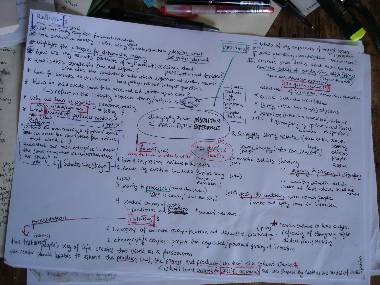
After an oh so long time in the field, I’ve finally got around to make a summary of some good advice I’ve returned to from time to time during my stay. They’re rather commonsensical knowledge for any graduate in anthropology, but it’s surprising how quickly I get accustomed to the details of everyday life, and thus stop paying attention… (from Writing ethnographic fieldnotes (Emerson, Fretz and Shaw, 1995)).
[teaserbreak]
On focus: – how to look in-order-to write (p.26)
*) on a scene: take notice of initial impressions available to the senses
*) give priority to processes (rather than causes etc); what is occurring (rather than why)
*) look for practical concern of actors; – conditions and constraints
On description (p. 32-):
*) write down the details of key components of observed scenes and interaction
*) avoid generalising characterisations – be concrete!
*) concrete sensory details of the scenes, settings, objects, people, action and talk
*) concrete details of everyday life which show (rather than tell)
*) how are emotions expressed (careful with generalisations…)
*) sensory (rather than analytic) adjectives
*) verbatim (rather than summarised) dialogue
+ the accompanying gestures, facial expressions, movements, postures…
*) sensory imagery (rather than evaluative labels)
*) immediate details showing agency and process in situations, auditory and kinetic details – evoke all senses which recall the moment of the experience (p. 72)
*) specify the conditions under which people invoke and apply terms (p. 139)
On reflection:
*) self-consciously recognise my own fundamental orientations (p. 62).
*) avoid evaluative wording; – but when using an evaluative term describe what led to the judgement
*) highlight the process of determining meaning
*) how are my accounts products of my (implicit) decisions about participation and description?
*) how do social events come to be perceived and written up as data? → reflect on the interplay/dialectic relation between theory/analysis and the creation of data. (Data are products of prior interpretative and conceptual decisions (p. 167).
*) which incidents/experiences toughed off particular attention and interests?
*) “see how our own renderings of others’ … worlds can never be descriptions from outside that world … understand our own enterprise in much the same terms that we understand those we study” (p. 216)
On writing:
*) remember the interplay of concrete exemplification and discursive commentary (p.174): – remain sensitive to how analytic reframing of ethnography might distort (local) meaning
*) when giving ethnographic examples; present the negotiated, processual quality of interaction (p. 175).
*) remember when presenting: the text about people’s way of life creates that world as a phenomenon for the reader (p. 214).
*) the reader should be able to assume the producer (i.e. me), the research process and the product (the text) as a coherent whole → (what I learnt occurred on spesific occations and was shaped by methods and modes of participation) (215).
I’d love to see an actual reproduction of a page from your fieldnotes – just to get an idea of how you work, the sort of things you record, et cetera. I think it would be very interesting!
Hi Bryan, and thanks for your comments (sorry for never getting around to answer the first one…).
Unfortunately – and, of course… – my notes don’t look like the way I would like them to look. When I get too excited about what people are saying, I forget to write about all the other stuff like their appearance, facial expressions, movements and the environments and so on, and likewise; when nothing really interesting happens I make all these detailed and probably useless notes about everything. And when I’m participating fully, I end up not taking notes at all…
I prefer taking notes as things happen, and not afterwards (I have to admit that I find it almost unbearably boring to sum up an event afterwards, so I do it much too rarely). Luckily, Parisians don’t seem to find people with notebooks (and cameras) strange at all.
But at least I’ve got into the habit of alerting myself each time I make a generalisation: why do I categorise like this? I think to try and avoid generalisations has been a really interesting exercise.
After my previous fieldwork I noticed that I hadn’t enough notes describing atmospheres and environments, how people look and dress, living room decorations and interiors of clubs and so on. I think at the moment I experienced all these things I was sure I was going to remember how it was as well as the impressions they made on me – of course that was not the case. So now I try to be sensitive to some of these environmental details one so easily take for granted when one is in the middle of it. This time I’m also taking a lot of photos, which will make it easier to remember.
I’ve flipped through my last notebook and very few pages there seem readable to others (neither to me, sometimes). Complete sentences are rare, Norwegian and faulty French are jumbled together (in the beginning I also used English but not anymore), the pages are full of
question-marks, and square and round parentheses marking off side-comments, reflection or descriptions, and dots marking incomprehension or that time has passed. When I look at it I start to doubt that these notes will ever serve anything else than mnemonic devises at the time I jotted them down ☺