search expand

– Use Anthropology to Build A Human Economy

Book launch
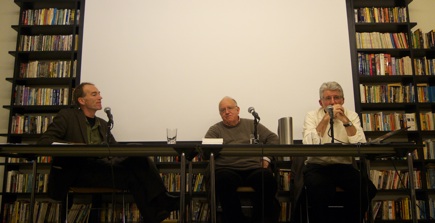
Book launch in the House of Literature (Litteraturhuset) in Oslo with Thomas Hylland Eriksen, Keith Hart and Desmond McNeill. Photo: Lorenz Khazaleh

Anthropologists, sociologists, philosophers, economists and activists have come together and written a citizen guide for a human economy.

In The Human Economy more than 30 authors from 15 countries show alternatives to our current dominating economic system.

Anthropologist Keith Hart launched the book Friday last week in Oslo together with two contributors: Thomas Hylland Eriksen and Desmond McNeill.
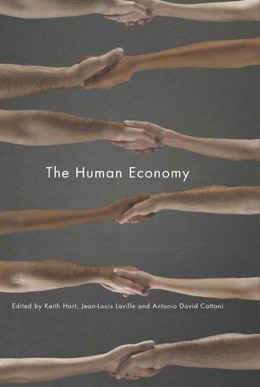
The table of contents looks promising: There are essays on for example solidarity economy, community participation, fair trade, ecological and feminist economics, alter-globalisation, social entrepreneurship and also articles on two topics that are especially relevant when we’re sitting in front of the screen: gift economies and digital commons.

I like the authors’ approach. They are not dreaming of an obscure and distant revolution. We don’t need a revolution. The alternatives do already exist, explained Keith Hart in Oslo:

The problem with posting an radical alternative to the socalled capitalist economy is that it raises question how do you get there from where we are.

What I want to argue is that the economies are much more plural than ideologies or conventional theories make them out to be. We live in a world in which we say if we can identify the economy as capitalist we’ve somehow done the job. Or if we want to build another one and call it socialist we’ve done the job.

My notion is that we live by a large numbers of economic principles which includes family economy, the importance of the state as an agent to redistribution, voluntary associations, NGOs etc

If we want to push the world economy in a new direction, then we should build it on what people are doing already – even if what they are doing already is marginalised, obscured or even repressed.

Keith Hart made me think of what I wrote nearly ten years ago when I prepared my final exam in economic anthropology. The more I read about Kula, Potlatch and other gift economies in distant places, I wrote (in German only), the more I got convinced of that we are operating in a similar way, that capitalisms’ importance is overrated. I found lots of examples of local exchange trading systems, even in my neighborhood, that work without any money involved: You repair my bike, and I’ll help your with your English homework.

The internet is a huge gift economy. Wikipedia, Flickr, blogging, we’re giving away our work for free. Or think of the free software movement or the way science works. Capitalism dominates only a small part of our economic system.

The authors are optimistic. It’s more easier than ever to realise a Human Economy. In the introduction (pdf), editors Keith Hart, Jean-Louis Laville and Antonio David Cattani write:

This world is massively unequal and voices for human unity are often drowned. But now at last we have means of communication adequate to expressing universal ideas. Anthropologists and sociologists have shown that Homo economicus — the idea of an economy based on narrow self- interest, typified as the practice of buying cheap and selling dear — is absent from many societies and does not even reflect what is best about ourselves. We ought to be able to do better than that by now. But ideas alone are insufficient. Emergent world society is the new human universal – not an idea, but the fact of our shared occupation of the planet crying out for new principles of association.
(…)
The Human Economy is a work of reference that has come out of a dialogue between successful social experiments in many parts of the world and theoretical reflection on them. The resulting synthesis is an invitation to advance knowledge along the lines we have begun and to dare to build a better world.

Unfortunately, this “citizen guide” exists on paper only. I asked Keith Hart if a webversion is in the making. His answer was No. Lack of time. “I’m totally overworked”, he said.

I’ll try to write more about the book in the coming weeks.

>> short presentation of the book on Keith Hart’s blog’

>> download the introduction (pdf)

>> After the Crash : A Human Economy for the 21st Century (published in Revue du MAUSS permanente)

>> read Keith Hart’s book “The Memory Bank. Money in an Unequal World” and his blog

SEE ALSO

How anthropologists should react to the financial crisis

Used anthropology to predict the financial crisis

What anthropologists can do about the decline in world food supply

The last days of cheap oil and what anthropologists can do about it

The Internet Gift Culture

Why were they doing this work just to give it away for free? Thesis on Ubuntu Linux hackers

Anthropologist uncovers how global elites undermine democracy

Democratic Publishing = Web + Paper

Book launch

Book launch in the House of Literature (Litteraturhuset) in Oslo with Thomas Hylland Eriksen, Keith Hart and Desmond McNeill. Photo: Lorenz Khazaleh

Anthropologists, sociologists, philosophers, economists and activists have come together and written a citizen guide for a human economy.

In…
Read more

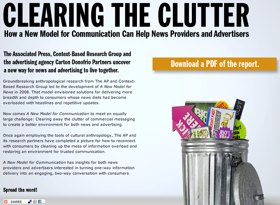
The end of one-way communication – Anthropologists help news providers and advertisers

For the second time, Associated Press has engaged anthropologists in order to improve its services. The first research project, conducted by Context-Based Research Group, revealed that people – contrary to what AP believed – wanted more breadth and depth instead of short blasts of news. The new study shows that news consumers want a two-way conversation instead of one-way bombardment:

It is not just that people feel overloaded. As consumers, they long for a better way to communicate with information providers – news companies and advertisers alike. They want that communication to be two-way, transparent and honest. They seek a new relationship that is built on trust, not simply on the value of the content or advertising itself.

“You have to socialize the space before you can monetize it,” Robbie Blinkoff, principal anthropologist for Context, concluded. “The solution is not just to create more engaging content, but to create better environments for engaging with content.”

In the report, Blinkoff used Victor Turner‘s concept “Communitas” – something that APs Vice President Jim Kennedy Vice President called “an interesting bit of cultural theory”:

He called Communitas a time of egalitarian information sharing which can be harnessed to rebuild trust between information providers and consumers. He likened Communitas to the social networking phenomenon online, where consumers feel comfortable engaging with information among their friends and peer groups. (…) With Communitas, there is no such thing as one-way communication. There are only two-way conversations that inspire loyalty and trust, and those are key ingredients with the power to cut through the clutter of the Internet.

Both studies are based on ethnographic research methods. The researchers tracked and analyzed the behavior of individuals in their work and home environments.

AP seems to be fascinated by anthropological methods. “One of the keys to understanding how to address the situation”, AP writes, “has been the extraordinary insight enabled by the Context methodology”:

Context does ethnographic research, meaning it studies small groups of people up close to get at the root of their behavior. That “Deep Structure,” as Context calls it, opens up a view of how companies can respond to cultural changes that aren’t so obvious on the surface.

>> press release

>> download the research report “A New Model for Communication: Studying the Deep Structure of Advertising and News Consumption”

I found one more report on Context’s website called Grounding the American Dream: An Ethnographic and Quantitative Study on the Future of Consumerism in a Changing Economy where they “portray a society and culture going through a “rite of passage” and moving into an era where we measure the quality of our lives in social terms before economic ones”.

SEE ALSO:

How to get more young readers? Associated Press turns to anthropologists

The Internet Gift Culture

“Prosumers”: Consumer Anthropologist Uncovers Proof of New Species of Consumer

Exploring the honor culture of social media

Ethnographic study: Social network sites are “virtual campfires”

Digital Anthropology Report: Attitudes to technology = basis of future class divides

Popular IT-anthropologists: Observe families until they go to bed

For the second time, Associated Press has engaged anthropologists in order to improve its services. The first research project, conducted by Context-Based Research Group, revealed that people - contrary to what AP believed - wanted more breadth and depth…

Read more

Exploring the honor culture of social media

How can businesses profit from social media? How does social media challenge what is regarded as “value” in the business world? Anthropologist Lene Pettersen discusses these and other questions in her paper “The impact of social media for business“.

Lene Pettersen, one of the few web2.0-anthropologists in Scandinavia, sent me this article that she previously has published on Slideshare

She writes:

‘Value’ in a strong economic sense is challenged by social media as a door opener for influence that the organizations should take seriously. (…) The market is a part of individual and collective projects where emotions and identities are expressed, and can therefore not be defined by monetary values alone (Olsen 2003). (…)
The virtual market isn’t a huge collection of passive consumers; it is represented by networks of people having meaningful dialogues and interaction with both each other and the businesses as such, and represents new ways of market power. (…) By mapping different social media applications that are used for interaction we will receive great insight of benefits from different social media tools, technology as such and give important knowledge of how social media can be used by companies and organizations for innovation.

For businesses to be successfull they have to establish a good reputation. She quotes anthropologist Tian Sørhaug who states that “we no longer can divide production from consumption, because it is difficult to separate the person and the product. In these online times we all are dependent on our reputation.”

Pettersen draws our attention to a kind of “honor culture” among bloggers and compares it to the Kula exchange:

In social media we can recognize how highly respected bloggers receive respect from others. In parallel to honor cultures, where public reputation is more important than one’s self esteem, bloggers achieve huge respect within their community (Pettersen 2009). Anette Weiner showed in her studies of the Trobriand people how transaction of the kula (a type of shell) with people’s kula network didn’t have a solely economic value, but that knowledge, high status, and even sorcery help kula players claim success and circulate their fame (Weiner 1988:156).

>> download the paper (pdf)

SEE ALSO:

The Internet Gift Culture

Mobile phone company Vodafone gets inspired by traditional Kula exchange system

Dissertation: Why kids embrace Facebook and MySpace

Ethnographic study: Social network sites are “virtual campfires”

Interview with Michael Wesch: How collaborative technologies change scholarship

How can businesses profit from social media? How does social media challenge what is regarded as "value" in the business world? Anthropologist Lene Pettersen discusses these and other questions in her paper "The impact of social media for business".

Lene Pettersen,…

Read more

Online: New book on the cultural significance of Free Software

cover

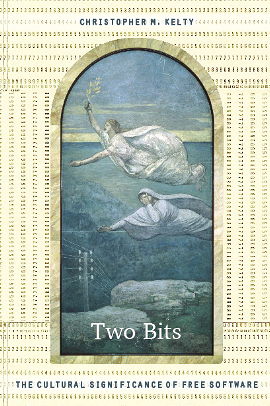
How has Free Software transformed not only software, but also music, film, science, and education? Anthropologist and Savage Minds blogger Christopher M. Kelty explores this question in his new book “Two bits” that now is “available for purchase, for download and for derivation and remixingas he writes.

A really web 2.0 book in other words. It is both available on paper (published by Duke University Press) and online – freely accessible. Both book, blog and wiki!

From the book description:

Drawing on ethnographic research that took him from an Internet healthcare start-up company in Boston to media labs in Berlin to young entrepreneurs in Bangalore, Kelty describes the technologies and the moral vision that binds together hackers, geeks, lawyers, and other Free Software advocates.
(…)
Kelty shows how these specific practices have reoriented the relations of power around the creation, dissemination, and authorization of all kinds of knowledge after the arrival of the Internet.

>> more information about the book

>> website of the book

SEE ALSO:

Why were they doing this work just to give it away for free? Thesis on Ubuntu Linux hackers

2006 – The Year of Open Access Anthropology?

The Internet Gift Culture

Ethnomusicologist uses website as an extension of the book

cover

How has Free Software transformed not only software, but also music, film, science, and education? Anthropologist and Savage Minds blogger Christopher M. Kelty explores this question in his new book "Two bits" that now is "available for purchase, for…

Read more

Why were they doing this work just to give it away for free? Thesis on Ubuntu Linux hackers

thesis-cover

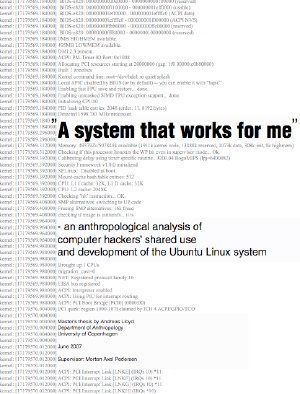
It all started when anthropologist Andreas Lloyd (University of Copenhagen) was browsing on the Internet looking for a new laptop computer and ended up installing the free Windows alternative Linux. Two years later, he finished his master thesis “A system that works for me” – an anthropological analysis of computer hackers’ shared use and development of the Ubuntu Linux system.

The thesis is a study of the Internet Gift Economy. Linux is developped by computer geeks saround the world, collaborating over the Internet, building a computer operating system in their spare time, which can be downloaded, installed, used and modified completely for free. It is among the biggest and most complex engineering projects ever conceived and built:

Based on more than 2 years of daily use of the Ubuntu Linux system and 6 months of online and in-person fieldwork among the developers working to develop and maintain it, this thesis examines the individual and collaborative day-to-day practices of these developers as they relate to the computer operating system that is the result of their labour.
(…)
A group of Spanish computer scientists measured the size of a Linux system similar to Ubuntu, and found that it contained around 230 million lines of source code. When they translated this into the effort spent on writing this code using a standard software industry cost estimate model, they found that it would correspond to almost 60.000 man-years of work (Amor-Iglesias et. al. 2005). By comparison, it took an estimated 3.500 man-years to build the Empire State Building in New York, and 10.000 man-years to build the Panama Canal. This immense effort makes modern operating systems such as Ubuntu among the biggest and most complex engineering projects ever conceived and built.

So the anthropologist was curious to learn more about how the hackers collaborate to build such an intricate system, and to learn why they were doing all of this work just to give it away for free.

How do you do fieldwork among hackers around the world? He explains:

I joined the Ubuntu on-line community on the same terms as the Ubuntu hackers, contributing to and using the same system, sharing their experiences with the system, and meeting them in-person on the same terms as they do at the conferences at which they gather, experiencing the same social and technical means and limitations through which they develop the system.
(…)
In order to do participant observation in this on-line space, I began contributing to the system by writing the system help and documentation, rather than the system itself due to my lack of technical understanding. In this way, I could take part in shaping Ubuntu alongside other community members while slowly developing a feel for the everyday exchanges and work in the community.

His thesis is by the way neither dedicated to any girl friend nor his parents:

In the true digital spirit of this work, I dedicate this thesis to Rosinante, the laptop on which I first experienced the Ubuntu system, and which was my faithful companion during my fieldwork and the writing of this thesis, only to bow out a week before tsafe for so long.

>> download the thesis

(Links updated 11.1.17)

SEE ALSO:

The Internet Gift Culture

Open source movement is like things anthropologists have studied for a long time

Open Source Fieldwork! Show how you work!

Gift economies and open source software: Anthropological reflections

Why you always get a present you don’t want – Social Sciences and Gift-Giving

Mobile phone company Vodafone gets inspired by traditional Kula exchange system

Open Source Anthropology : Are anthropologists serious about sharing knowledge?

2006 – The Year of Open Access Anthropology?

thesis-cover

It all started when anthropologist Andreas Lloyd (University of Copenhagen) was browsing on the Internet looking for a new laptop computer and ended up installing the free Windows alternative Linux. Two years later, he finished his master thesis "A…

Read more